A new artist advice column with Derek Reese, Program Manager of Artist Services at Shiftworks, with new Q&As each month.
Ask Derek!

Q: What advice do you give to artists when they're writing a Letter of Interest?
A: For so many artist applications I see, the Letter of Interest, or LOI, seems to be treated like an afterthought, instead of the first-impression that it really is.. An LOI is a one- to two-page professional letter addressed to a person or group of people (like a selection panel) that introduces you, identifies the opportunity you are applying for, and makes the case for why you are a good fit.
Before email became the norm, an LOI was an actual letter that you would type, fold, put in an envelope, and mail to someone. Crazy, I know. These days, writing a letter might seem like a needlessly formal or outdated element of an application, but it’s actually your first opportunity to make a big impression. Unlike an artist statement, which describes you, your art, and your studio practice, an LOI is about the relationship between you, your studio practice, and the specific opportunity. Ultimately, I think a good LOI should convince the reader of three things: your work is compelling; this opportunity is not only meaningful to your practice, but the hiring entity will benefit from selecting you; and you will be a reliable and cooperative person to work with.
I’ve outlined the key elements of what I think makes a good Letter of Interest here:
Formatting
There is no need to reinvent the wheel when it comes to formatting an LOI. I recommend sticking with a traditional letter format. Use left-aligned text, standard one-inch margins, and a clean, professional font such as Arial or Calibri at 11 or 12 points. 1.15 or 1.5 line spacing looks best, in my opinion, as opposed to single or double spacing. And finally, avoid overly decorative fonts. Save your creativity for your art work.
The Heading
You can include a fancy header with your name and contact information, and even a small headshot, or you can simply use a traditional heading block, as outlined below. Either way is fine, but I would err on the side of plain and direct. Your heading block, should look something like this:
Your Name
Your Fine Art Discipline (Optional)
Your Phone Number, Email Address
Link to Your Website / Online Portfolio URL
Your City, State, ZIP Code
Today’s Date
Recipient Name or Committee Name
Title (If applicable)
Organization / Gallery Name
Street Address
City, State, ZIP Code
The Salutation
Please, do your homework for this. If the opportunity information identifies a specific person who will be reviewing applications, address the letter to that person. Be sure to include their professional title, if relevant. For example, “Dear Prof. Smith, ” or “Dear Dr. Smith.” If the person does not seem to have a professional title like a doctor or Professor, I would avoid guessing if they use Mr., Ms. Mrs., etc. Unless you know for sure, I recommend simply saying their first and last name. For example, “Dear Michelle Jackson.”
If you cannot identify an individual, see if you can determine whether there is a selection committee. In that case, “Dear Search Committee” is perfectly appropriate.
Be sure to avoid “Dear Sir or Madam” or similarly generic salutations whenever possible. Taking the time to figure out who you are actually addressing demonstrates that you have taken the opportunity seriously.
Paragraph 1: Tell Them Why
The first paragraph should quickly establish what you are applying for and why you are interested. You don’t need to spend half the page getting to the point. Tell the reader what opportunity you are applying for, and give them a brief sense of why you are excited about it, and why you’re a good fit.
Whenever possible, demonstrate that you have actually researched the opportunity. Mention a specific program, resource, piece of equipment, community, location, person, or aspect of the organization that interests you.
This is one of the easiest ways to distinguish a thoughtful LOI from one that feels like it was copied and pasted from another application.
Paragraph 2: Tell Them About Yourself
The second paragraph is where you can dig a little deeper into your practice and describe more about why you are interested. Talk about the aspects of your work that are most relevant to the opportunity. Depending on the application, this might include your education, previous exhibitions, public art experience, community engagement, technical skills, collaborations, or other accomplishments.
The important thing is relevance. You do not need to provide your entire résumé in paragraph form. Instead, think about what the reader needs to know in order to understand why your experience prepares you for this particular opportunity.
And remember the advice I gave in my post about writing artist statements: you are enough. You don’t need to make yourself sound more important by piling on complicated language or every accomplishment you’ve ever had. Be specific. Be honest. Let your actual experience make the case for you.
Paragraph 3: What You Bring to the Opportunity
The third paragraph is an important one because it shifts the focus from what the opportunity will do for you to what you will contribute to the opportunity. A selection panel isn’t only asking, “Is this person a good artist?” They are also asking, “What will it be like to work with this person?”
Ask yourself these questions as you write: What are you excited to explore?; What perspectives, skills, or experiences do you bring? What are you looking forward to doing with the organization, community, or other artists involved? This is particularly important for opportunities that involve collaboration or community engagement.
This paragraph is where you can demonstrate that you understand the opportunity as more than a line on your résumé. Show that you are thinking about the people and circumstances surrounding the work.
Paragraph 4: Bring it Home
Your final paragraph should briefly bring everything together. Reiterate your enthusiasm for the opportunity, summarize why you think you are a good fit, and thank the reader for their time and consideration.
In concluding the paragraph, there’s no need for dramatics. Act like you’ve been here before. Something as simple as “Thank you for considering my application. I would be excited for the opportunity to contribute my experience and perspective to this project” can be much more effective than trying to end with an overly dramatic or poetic statement.
Before You Send it
As with any writing that you are sending out into our critical world, be sure to share your draft with friends, family, or coworkers to read. Do they understand what you’re saying? Are there critical grammar or punctuation errors that you missed? I always recommend getting a round or two of feedback and reworking your writing before sending it off.
As always, you can share any type of application material for me to review in advance of sending it off. I offer office hours on Mondays (virtually) and Thursdays (in-person) every week. You can use the links below to schedule a time with me.
Q: What advice do you give to artists when they're writing their artist statement?
A: At some point, every artist realizes that writing becomes part of the job. The good news is that the same curiosity and honesty that fuel your artwork can also guide your writing.
A quick note before I proceed: the following is an answer to the question pertaining to artist statements, but the advice can be applied to any writing that artists are asked to produce in their professional lives such as bios, exhibition statements, letters of interest, grant applications, and so on.
Not Just One Statement Will Do
First, there’s no single formula for a great artist statement. Just like there’s no single formula for great art. The tone, structure, and content of your writing should depend on the artist’s practice, the audience reading it, and what the artist hopes to convey or accomplish. A curator, a collector, and a grant panel are all different audiences that probably require different approaches to your writing. Expect that you’ll need to tailor your statement depending on who it’s for.
In addition to considering different tonal versions of your artist statement based on the audience, the same goes for the length of your statement. I strongly recommend maintaining three versions of your statement: a full one-pager (around 500 words), a half-page version (around 250 words), and a short blurb or “elevator pitch” (about 50 words). Having three versions at the ready will come in handy when opportunities require artist statements with varying word limits, and the process of creating them is just as valuable. Writing a one page artist statement, and then challenging yourself to shorten it by half, and then by half again is one of the best studio exercises for identifying what truly matters in your practice. What survives the edits is usually the core of what you’re trying to say.
More broadly, I think the most effective artist statements emerge when artists treat writing as an extension of their creative practice. Ask yourself: How can the way I write parallel the way I make art? When the two feel connected, the writing becomes clearer, more honest, and far more compelling.
There are also a few rules I personally follow—and appreciate seeing applied when reviewing artist applications.
Leave the Academic or Overly Technical Writing At School
Many artists, myself included, come out of school thinking that “good” writing needs to sound complicated or theoretical. It’s as if we have come to the conclusion that the more long and esoteric the words, the more worthy the artwork. Often, this approach has the opposite effect. This way of writing can be painful to produce and even harder to read. A helpful guideline that I try to follow is to write as if you’re explaining your work to a close friend who may not have a background in art. In the real world, clear language doesn’t make your work less sophisticated—it makes it accessible.
You Are Enough
Rule #2 is somewhat an extension to rule #1. When artists write honestly and directly about what they’ve made and why, the result is usually far more compelling than trying to persuade the reader that the work is important. Sometimes when I read artist statements, the phrase “show me, don’t tell me” pops into my head. It’s as if the artist is trying to convince me that they are worthy as artists by needlessly inflating elements of their statement. If the enthusiasm and intention behind the art work come through naturally, the statement will do its job. Trust yourself.
Let Your Art Do the Art-ing
Unless you’re a poet or creative writer, your artist statement isn’t helpful as a piece of art in itself. When helping artists with their statements, I encourage them to think of their statement as a user’s manual, or viewer’s manual that provides an access point helping someone understand the art they’re seeing. Overly poetic, grandiose, or esoteric language can obscure more than it reveals. In my experience, clarity and authenticity and a straight-forward manner will take you much further. In the end, the best artist statements don’t try to impress the reader. They bring context and clarity to the artwork. And when honest writing becomes part of your creative rhythm, it can actually deepen the way you think about and make your art.
Q: Where should I look to find public art opportunities?
A: There are seemingly countless resources for finding public art opportunities online. Seeking out these lists is overwhelming and may leave you wondering how many opportunities you might not be seeing.
I’d like to share some resources that we use at Shiftworks, and that I use myself as an artist. Hopefully, this list can help add some clarity and focus in your search. Also, I’ll only be including resources that are totally free and do not require a membership or creating an account. Because who has the time or money for that?
Public Art Opportunities
For opportunities specific to public art, I may be biased, but I recommend first checking Shiftworks’ Artist Opportunity List because we do a lot of the work for you, scanning various local, regional, and national resources, and compiling them here. We are one of the few resources in the country that compile only public art opportunities and furthermore, only those that are free to use and do not require a membership. You can sign up for our mailing list and we will deliver a list of opportunities to your inbox.
Another public art-specific local resource is the City of Pittsburgh’s Public Art Hub which provides information on the city’s public art collection, new artist calls, ongoing public art projects, and more. In fact, many city and state governments post public art information on their websites. So, if you are interested in working in a particular area, take a look at government websites. A great example is the City of Seattle’s Office of Arts and Culture’s website.
National and International Opportunities and Resources
For a more broad spectrum of national opportunities and resources beyond public art, there are a couple great locally-based artist opportunity lists to explore that, as an artist myself, are my go-tos. First, is the Artist Opportunity Blog by Associated Artists of Pittsburgh. They do a fantastic job of compiling an impressively comprehensive list of opportunity types including exhibitions, residencies, fellowships, grants and awards from across the country. The Greater Pittsburgh Arts Council’s Arts Blog is also a great resource that posts arts-related employment opportunities that I explore regularly
Another primary resource for me is The Artwork Archive’s Complete Guide to the Best Artist Opportunities which has an impressive search component for finding specific opportunities from across the globe based on various filters including the types of opportunities (including public art); art mediums specific to the opportunity; specific locations; and whether the opportunity is free to apply, includes a stipend, etc.
There are a multitude of other resources that focus on international opportunities. Some honorable mentions include ArtRabbit, ARTENDA, and Artwork Archive.
Happy searching, and remember, if you find something you want to apply for and want additional advice, you can sign up for Office Hours with me.
Get Help with Office Hours
Office Hours is a free service offered either in-person or virtually.
To sign up for a 30-minute meeting with Derek Reese, please visit the links below.
Image credits
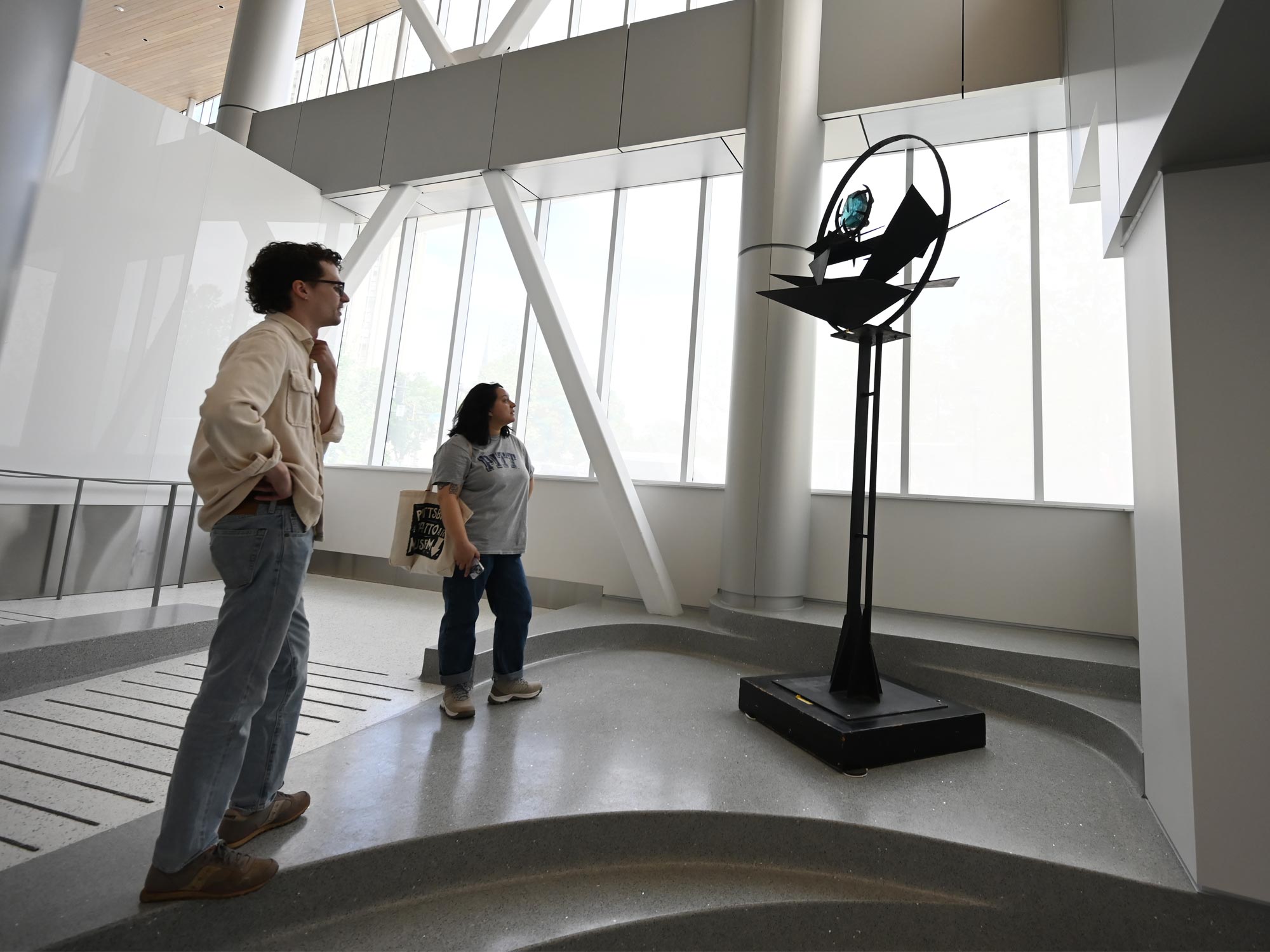
(1) Derek’s headshot – Photo by Trey Duplain; (2) Visitors at the UAG observing Flight by Virgil Cantini, 1965. Photo by Aimee Obidzinski.